- The movie book touches on some interesting points but I feel it focuses on gangsters and other hollywood archetypes opposed to what I am specifically researching
- Tailoring books are great in relation to the practical work
- Need to make schedule for self directed
Monday, 27 May 2013
Self directed
Researching bits and bobs

Entry 15:Plaster and Modeling
Plaster and Modeling
Materials needed:
can use modeling and painting tools for clay shaping. suggested that gray modeling clay is used.
Always take into consideration
-material
-skill
-need
-and time
first be sure to cover object in cling film

press clay on and smooth out


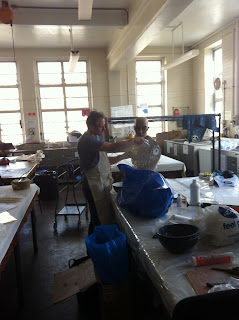


Materials needed:
- gray modeling clay
- tools
- scrim- soft hemp netting used for re-enforcement
- plaster
- water
- bowl(s)
- silicon -the tubes of clear silicon you get at a hardware store for caulking around you sink are perfect
can use modeling and painting tools for clay shaping. suggested that gray modeling clay is used.
Always take into consideration
-material
-skill
-need
-and time
first be sure to cover object in cling film

press clay on and smooth out

Add whatever designs you want by etching into clay or building up with more clay

put water in bowl- add plaster till you see islands forming. Plaster should be just think enough to cover and your hand but still thin enough to drip off.
flick first layer on, be sure to blow on it a bi to eliminate air bubbles

2nd coat it the re-enforcement, cover the 2nd coat with scrim. Dip scrim into the plaster and apply to clay. by doing this and giving it texture it will make the next layer hang on better

'rope' the edges of your clay, by making rope shapes with scrim and then putting around the edge.
the plaster shouldn't take to long to dry and you can then pry it off of the clay


be sure to pick the clay out of any crevasses

then fill your mold with silicon.
NOTE: paint can be added to clear silicon to give it colour, but it must be acrylic paint as water based paint will not mix with it. if wanted glitter could be added as well.


The silicon will take longer to dry. if it is hard to get out of the mold put it in water to get it out.
Sunday, 26 May 2013
Entry 14:Work Placement
For one of my work placement opportunities I had the pleasure of working for Charlotte of Wilden Bride London
Charlotte owns and operates her own bridal business in which she makes bespoke bridal gowns for women. Her process includes meeting with the bride to discuss budget and what aesthetics the bride is drawn to and then designing and building a dress based off of those decisions.
Her main advisement is word of mouth and photo shoots, that's where I come in. She has been asked by Rosie Weisencrantz Jewlery to create a garment to be worn to with a jewlery piece in an upcoming photo shoot. The theme of this photo shoot is Romeo and Juliet.
First Charlotte shows me the moodboard they've created through pintrest so I can get and idea of what style they are going for, next she explains to me her idea of what she would like the end result to be (roughly). Which is a plain dress with a sheer embleished top over it, and asks me if i would like to make that top.


during my first day with her I was asked to cut the top on the stand and pick out some beads, sequins and other bits and bobs to possibly go on the top. after which she sewed it and sent it home with me.
Over the next couple weeks I've worked on a couple different ideas for the top, showing Charlotte pictures via email to get her opinion and 'yeses' and 'nos'.


The photo shoot isn't scheduled to happen for a while yet but I am really excited to get to add the pictures to my portfolio.
I think some of the things that I have gained from this experience is working with a designer more verbally opposed to just being handed a picture of exactly what's wanted. I have got to have a lot of experimentation and freedom with this project while still having someone to report back to telling me if I'm on the right track or not. Charlotte is very sweet, sometimes can be overly sweet so I've had to learn to adapt to understand her gracious way of saying that she doesn't like something.
I greatly look forward to my next work placement opportunity which will be working for another designer to make a couple pieces for a photo shoot as well (ironically enough). I'll be interested to see how my next project which is more of a costume piece and for a more strong willed designer compares and contrasts with the experience I've just had.
Charlotte owns and operates her own bridal business in which she makes bespoke bridal gowns for women. Her process includes meeting with the bride to discuss budget and what aesthetics the bride is drawn to and then designing and building a dress based off of those decisions.
Her main advisement is word of mouth and photo shoots, that's where I come in. She has been asked by Rosie Weisencrantz Jewlery to create a garment to be worn to with a jewlery piece in an upcoming photo shoot. The theme of this photo shoot is Romeo and Juliet.
First Charlotte shows me the moodboard they've created through pintrest so I can get and idea of what style they are going for, next she explains to me her idea of what she would like the end result to be (roughly). Which is a plain dress with a sheer embleished top over it, and asks me if i would like to make that top.


during my first day with her I was asked to cut the top on the stand and pick out some beads, sequins and other bits and bobs to possibly go on the top. after which she sewed it and sent it home with me.
Over the next couple weeks I've worked on a couple different ideas for the top, showing Charlotte pictures via email to get her opinion and 'yeses' and 'nos'.


The photo shoot isn't scheduled to happen for a while yet but I am really excited to get to add the pictures to my portfolio.
I think some of the things that I have gained from this experience is working with a designer more verbally opposed to just being handed a picture of exactly what's wanted. I have got to have a lot of experimentation and freedom with this project while still having someone to report back to telling me if I'm on the right track or not. Charlotte is very sweet, sometimes can be overly sweet so I've had to learn to adapt to understand her gracious way of saying that she doesn't like something.
I greatly look forward to my next work placement opportunity which will be working for another designer to make a couple pieces for a photo shoot as well (ironically enough). I'll be interested to see how my next project which is more of a costume piece and for a more strong willed designer compares and contrasts with the experience I've just had.
Entry 13: Body Adorned
Body Adorned
Theories of Difference
Identities are constructed in relation to the 'other', that is in relation to what they are not. therefore the notion of 'difference' is integral to the construction of identities.
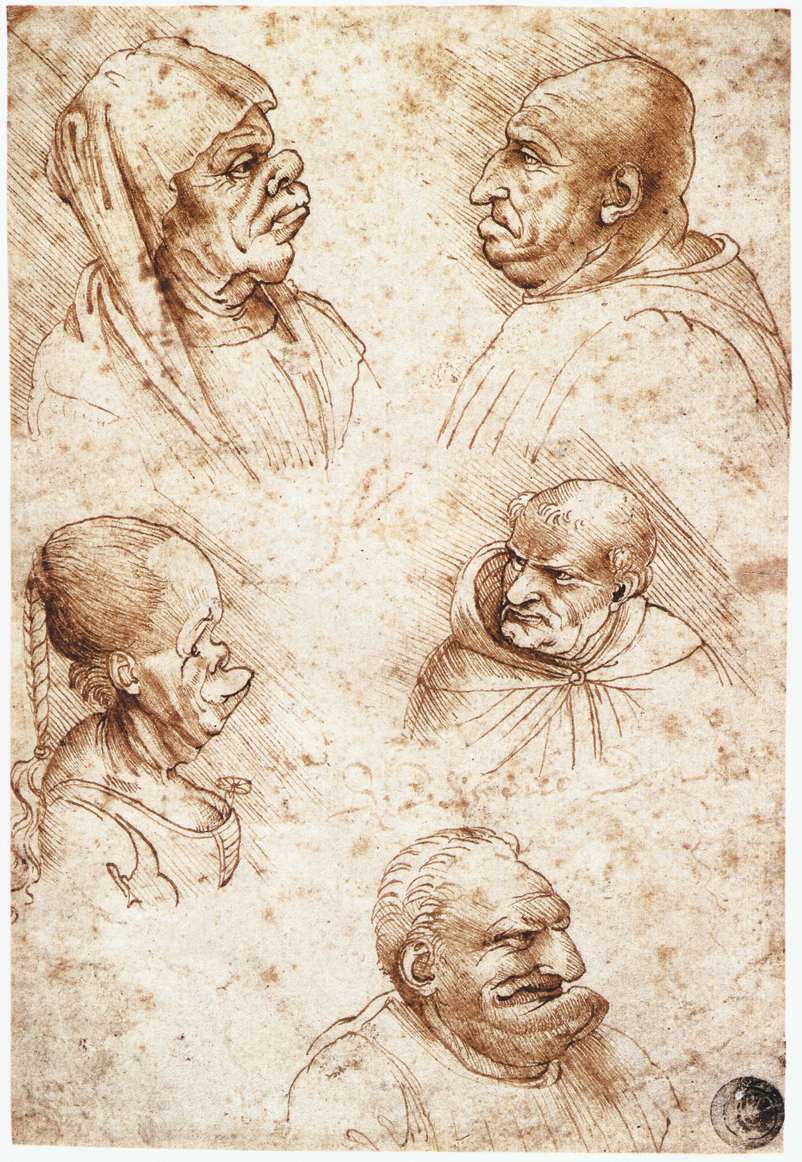
Heronimus bosch
The fool, the caricature heads--->ugliness is part of the world


Theories of Difference
Identities are constructed in relation to the 'other', that is in relation to what they are not. therefore the notion of 'difference' is integral to the construction of identities.
Heronimus bosch
The fool, the caricature heads--->ugliness is part of the world
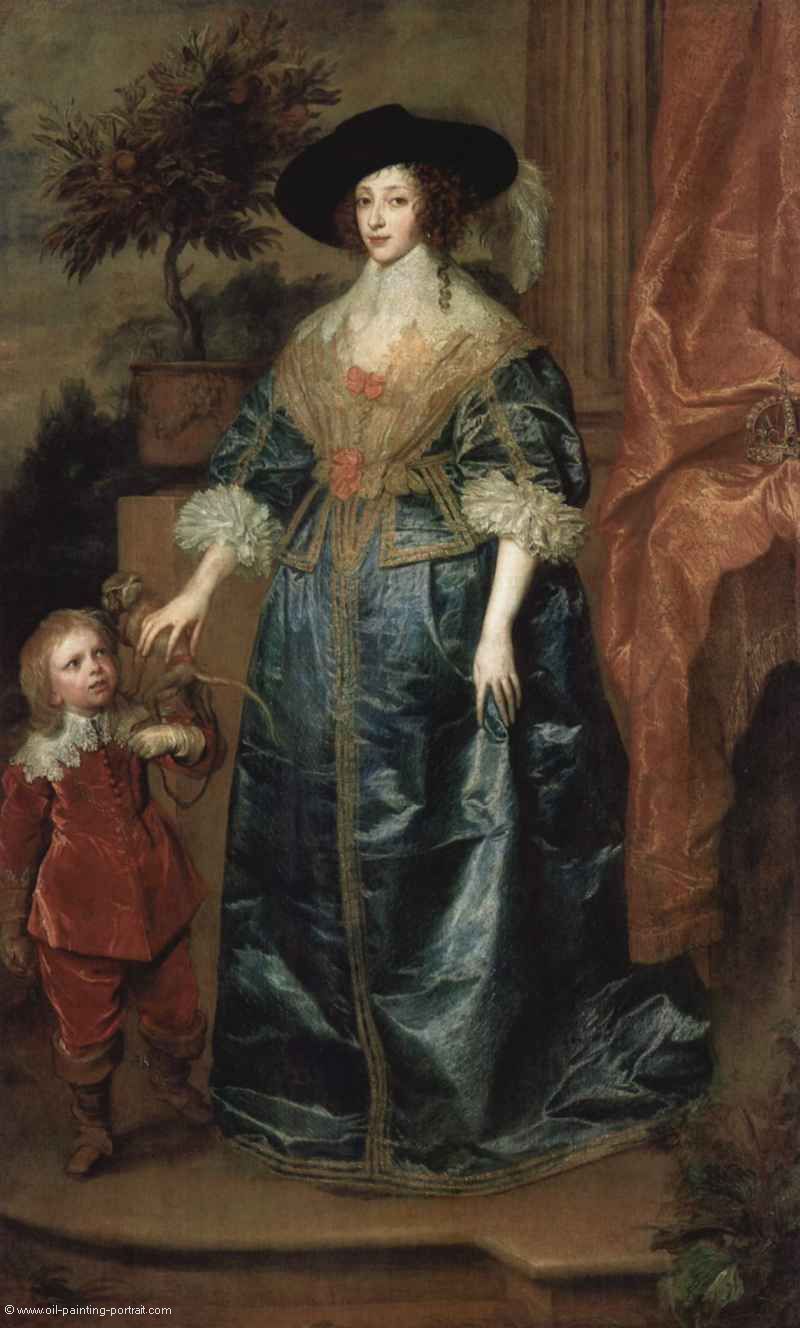
Henrietta Maria and her dwarf Jeffery Husdon- He is her harmless mascot and exists for her entertainment and pleasure, he is treasured for his difference but also looked down upon to some degree
As peoples knowledge of the world grew so did peoples fascination of the 'others' dark skinned people etc.
The concept of The ‘Other’ describes ways in which, as individuals and communities, we make sense of and construct the identities of people who are different.
HEGEL (1770-1831)
argued that one cannot make sense of oneself without the recognition of others.
He used: the Master (dominant) & Slave (docile) parable
dress is a way of subjecting people servants wear uniforms to show that they 'belong' to someone
slavery ended in Britain in the 1800's
in the states slavery and then segregation lasted for far longer finally ending (officially) in the 1950's
The spectacle of the East was exotic and thrilling.
the privileged ‘Western Gaze’ that depicts the previously hidden protected beauty of Oriental women. (a voyeuristic gaze)
School sometimes linked to sexual taboos of sadism and initiation of virgins.
Lady Mary Wortely Montague and early traveler she was fascinated by the oriental world and wrote many journals about her travels.
Odalisques (oriental nudes)

Many paintings are constructed worlds based on here say, many of the painters had never been to the orient.
The 'orient' is a term that only has meaning as a western construction. a concept exists in the west for the west. The Orient is timeless, it is strange, it is feminine
In the 19th Century the ‘Orient’ was carefully observed in order to:
- enable better colonization
- enforce own power and superiority
- The conceptualized ‘Other’, or the Oriental was perceived as inferior, alien, exotic, heathen, savage.
- they made assumptions about race and gender
Europeans denigrated or dismissed the 'others' way of knowing the world and being human
different=savage
would try to fix 'savageness'
Many scientists tried to prove differences in race, trying to show that western people where Superior
the exotic in modernism in the 20th c. a celebration of the exotic was central to the development of modern art and design
Bakst, Gauguin, Matisse
New social movements and legislation in contemporary multicultural societies have allowed marginalized groups to celebrate their differences publicly particularly in relation to gender sexuality and race
post colonialism
In Multicultural Societies built up in the contemporary Post-Colonial period, ‘Culture’ has become increasingly fragmented. It expresses much more diversity, and this is visible in dress.
Writers such as Edward Said and Stuart Hall have explored the notion of ‘The Other’ and ‘Difference’.
Edward SAID
Orientalism (1978)
Culture and Imperialism (1993)
saw: ‘Orientalism as a dogma that not only degrades its subject matter, but also blinds its practioners’
argues that: Representations of the Orient are for consumption within a dominant western culture. He critiques Colonial Orientalism and the oppressor-oppressed relationship
SAID opens up a new debate which is crucial in development of Postcolonial thinking. He provides a voice from the Orient.
Gayatri SPIVAK
Can the Subaltern Speak (1985)
A critique of Postcolonial Colonial Reason: towards a History of the Vanishing Present (1999)
Work operates at the intersections between postcolonial theory, feminism, deconstruction and Marxism.
She uses the term ‘the subaltern’, the inferior rank, to represent the colonized or peripheral subject.
She argues that personal cultural worth can be restored by questioning the patriarchal colonial discourse. She believes that ‘othering’ and ‘worlding’ can shape an awareness of connections and a new discourse exploring the concepts of the diaspora and interconnectedness.
Homi BHABHA
Nations and Narration (1990)
He believes in the ultimate superiority of the nation’s ‘inside’ over the ‘outside’.
Arguing that the margins of the nation can displace the centre. This intervention at the edges allows for ‘hybridization’ between cultures, the forming something completely new.

does this picture show someone wanting to be the opposite?

Monday, 13 May 2013
Entry 12: Body Adorned part 4- the body revealed
Body Adorned part 4
The Body Revealed

Sexual modesty


DELIGHT IN DISORDER.
by Robert Herrick
by concealing the body clothing can excite sexual curiosity and create in the viewer the desire to remove them
Freud- Interpretation of dreams-fetishism
Freud's theories related to human sexuality
he's concepts
voyeurism = looking->viewing something you shouldn't "peephole"
Narcissism =love of the self or things that look/relate to it
Fetishism = falling in love with an object perhaps one that symbolizes a person---> shoe fetish, shoes are sexual and represent the putting on one thing into another
Flugel- The psychology of clothes 1930
=an unconscious conflict between
The Body Revealed

Sexual modesty
- biblical ideals of modesty
- concealment and modesty also can function to arouse sexual passion
- all clothing is erotic
Around 14th c. tight clothing began to surface, this could be for arousal purposes
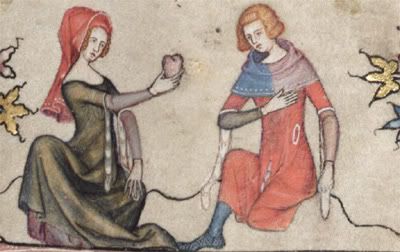
Fashion highlights the parts of the body that we find sexually arousing at that period of time
the toilet of venus

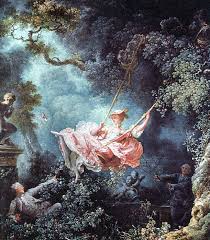
Dishevelment of clothing ca be seen as fashionable and perhaps erotic...clothes getting taken off or perhaps just being put back on
1670's was a promiscuous period
by Robert Herrick
| A SWEET disorder in the dress Kindles in clothes a wantonness : A lawn about the shoulders thrown Into a fine distraction : An erring lace which here and there Enthrals the crimson stomacher : A cuff neglectful, and thereby Ribbons to flow confusedly : A winning wave (deserving note) In the tempestuous petticoat : A careless shoe-string, in whose tie I see a wild civility : Do more bewitch me than when art Is too precise in every part |
by concealing the body clothing can excite sexual curiosity and create in the viewer the desire to remove them
Freud- Interpretation of dreams-fetishism
Freud's theories related to human sexuality
he's concepts
voyeurism = looking->viewing something you shouldn't "peephole"
Narcissism =love of the self or things that look/relate to it
Fetishism = falling in love with an object perhaps one that symbolizes a person---> shoe fetish, shoes are sexual and represent the putting on one thing into another
Flugel- The psychology of clothes 1930
- applies Freud's ideas of fashion
- sees fashion as displacement
=an unconscious conflict between
- 'modesty'- chastity
- 'exhibitionism' - eroticism
evening dresses and 'decolletage' 19th c. were frivolous low necklines showing off of shoulders
In the case of exhibitionism desires connected with self-displaying a particularly easy form of converion may be found in a change from...(find ED notes)
The Gaze
------------
is related to power and control
1973 laura Mulvey: "visual pleasure and narrative cinema", examines how women are portrayed in film applying the theory of scopophilla she argues that in hollywood the 'pleasure of looking' is determined by the 'male gaze'
cinema makes 'you' (the viewer)like the 'camera' you don't have the choice of were you look
The Cinematic Gaze
- gazing is a constitutive activity of the cinema
- the existed for the male gaze
The gaze is a key area in visual culture studies
-sexual difference is produced not a natural order
men+ gazing=active
women+ reclining= passive
- The gaze is a way of 'controlling'
- the gaze is about master and power, not just looking
- the gaze objectifies the body
Thursday, 9 May 2013
Entry 11: research for self directed
Research for Self Directed project
My idea so far is to make a pair of trousers as well as a tailored waist coat in the style of a western/country (gentle?)man
To tie it into body adorned I'd like to look at masculinity in the west during the mid 19th c.
I think it's an interesting time because in the southern states in America there was a sense of rugged refinement being a gentleman of the south but still owning plantations and farms. I feel that as people moved further out west the scale began to tip towards more rugged due to the necessity of survival, though many may have tried to hang on to some gentle nature.
So far some of the books that I've been looking at are
American menswear: from the civil war to the twentieth century by Daniel Delis Hill
Men's garments, 1800-1900: guid to pattern cutting and tailoring by R. I. Davis
Cutting and designing for men's tailoring by J. Cutler
American Victorian costume in early photographs by Priscilla Harris Dalrymple
Shirt making: developing skills for fine sewing by David Page Coffin
Undressing cinema: clothing and identity in the movies by Stella buzzing
I've also started a Pinterest board,
http://pinterest.com/madameminerva/a-little-bit-o-country/
My idea so far is to make a pair of trousers as well as a tailored waist coat in the style of a western/country (gentle?)man
To tie it into body adorned I'd like to look at masculinity in the west during the mid 19th c.
I think it's an interesting time because in the southern states in America there was a sense of rugged refinement being a gentleman of the south but still owning plantations and farms. I feel that as people moved further out west the scale began to tip towards more rugged due to the necessity of survival, though many may have tried to hang on to some gentle nature.
So far some of the books that I've been looking at are
American menswear: from the civil war to the twentieth century by Daniel Delis Hill
Men's garments, 1800-1900: guid to pattern cutting and tailoring by R. I. Davis
Cutting and designing for men's tailoring by J. Cutler
American Victorian costume in early photographs by Priscilla Harris Dalrymple
Shirt making: developing skills for fine sewing by David Page Coffin
Undressing cinema: clothing and identity in the movies by Stella buzzing
I've also started a Pinterest board,
http://pinterest.com/madameminerva/a-little-bit-o-country/
Entry 10: Body Adorned part 3
Body Adorned Part 3
The Gendered Body

Cross dressing was common all throughout history. Females weren't allowed on stage until the late 17th century.
Definitions
Sex=the biological characteristics of male and female
Gender= the socially and culturally produced attributes of "femininity" and "masculinity". Gender differences are not 'fixed'
Sexuality= the way one individual expresses desire for another, there are different sexual identities other than heterosexuality and homosexuality
Historical gender roles and relations
Breward (1995) culture of Fashion
‘The control of masculine and feminine appearance was constantly kept in balance, reflecting the authority in vested in constructions of patriarchal behaviour and demeanour, and the subserviant position of femininity in social discourse.’
The knight: masculine ideal
The romance of Alexander (1338-1344)
"Medieval superstars of masculinity"
The embroiders: feminine ideal
Album amicorum of gervasius fabricuis (early 17thc.)
The Gendered Body

Cross dressing was common all throughout history. Females weren't allowed on stage until the late 17th century.
Definitions
Sex=the biological characteristics of male and female
Gender= the socially and culturally produced attributes of "femininity" and "masculinity". Gender differences are not 'fixed'
Sexuality= the way one individual expresses desire for another, there are different sexual identities other than heterosexuality and homosexuality
Historical gender roles and relations
Breward (1995) culture of Fashion
‘The control of masculine and feminine appearance was constantly kept in balance, reflecting the authority in vested in constructions of patriarchal behaviour and demeanour, and the subserviant position of femininity in social discourse.’
The knight: masculine ideal
The romance of Alexander (1338-1344)
- Chivalry
- Protection
- Perfect virtue
- Defender
"Medieval superstars of masculinity"
The embroiders: feminine ideal
Album amicorum of gervasius fabricuis (early 17thc.)
- Nurturer
- Mother
- Wife
- Purity
- Home maker/tender
The courtier: ideal gentleman
Mattaus schwarz 1520-60
- Self possessed
- Good etiquette
- Highly esteamed
- Cultured
- Educated
The reader and the lover
Boucher (1756) Madame de pompadour
Even after her affair with the king of France died down she held the kings interest by reading, staying educated, and keeping up on current affairs.
Mengs (circ. 1760)
Giacoma Casanova
Celebrated pleasure. Upperclass. Seeking gratification. Egocentric. Many men would keep journals of their sexual conquests.
The Nurse and the Hero
caring patient vs. self sacrifice courageous
Sailors would have to do everything on ships including the duties that were usually considered "women's work", such as cooking cleaning etc.
The feminine world was calm women were considered to be almost decorative
20th century was one for man changes for women, in the late 19th c. suffragettes appeared (1910) grim but steely determination
Simone de Beavoir (1949) the second sex "one is not born a women but becomes one"
Feminism
15th c. PISAN (1405) "city of ladies" was written by a nun. she argued that women were capable of doing anything that a man could do
Micheal Foualt - Sexuality
caring patient vs. self sacrifice courageous
Sailors would have to do everything on ships including the duties that were usually considered "women's work", such as cooking cleaning etc.
The feminine world was calm women were considered to be almost decorative
20th century was one for man changes for women, in the late 19th c. suffragettes appeared (1910) grim but steely determination
Simone de Beavoir (1949) the second sex "one is not born a women but becomes one"
Feminism
15th c. PISAN (1405) "city of ladies" was written by a nun. she argued that women were capable of doing anything that a man could do
Micheal Foualt - Sexuality
- critical of all the previous accounts including psychoanalytical ones
- Sexuality is a set of discourse
- This explores power relations: anything outside 'heterosexuality' is seen as abnormal and perversion
- therefore sexuality discourses are a powerful form of control and regulated in society
- discourses that tell us how to experience and use the body -social constructionist
- Sociological rather than biological factors shape sexuality
Judith Butler (1990) Gender Trouble
The Ladies of Llandogen
two irish ladies who moved to wales in the 19th c. supposedly a lesbian couple, the would often dress in mens clothing together.
Interesting how the 20th c. early ideals of beauty boyish short hair flat chested
claude cahun
diana arbus
david bowe
Subscribe to:
Posts (Atom)